Diarrhea as a Message from the Body: Total Biology and the Trace of Family History
- Magic
- August 30, 2026
- 10 min read
- świadomość
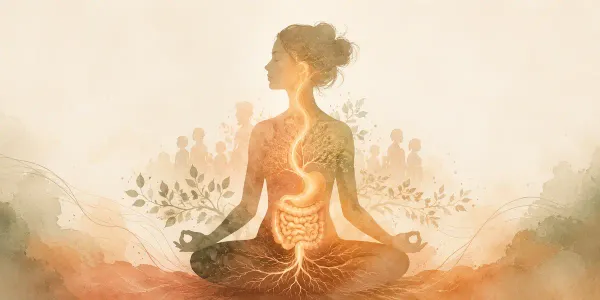
I’ve been writing for years about being aware of who I am, why I’m here, and what to do with that - and I’ll likely keep writing about it, because understanding this is key to living in harmony, happiness, and joy, even amid life situations that aren’t always easy to accept.
Despite my age, new points keep appearing on the map of my own awareness, and I think it’s worth “checking them off” in order to keep moving forward. There have been moments in my life when, in the middle of a conversation with someone, something suddenly clicked - the dots connected into a whole, as if they’d been waiting for exactly that moment. This text is about one such moment. And I hope it can help someone else find the same peace that comes from understanding this condition - diarrhea.
When diarrhea shows up regardless of what you eat - raw vegetables, fruit, or meat - that fact alone is an important clue. If diet isn’t the variable triggering the symptom, then the problem doesn’t lie on the plate. It lies somewhere else.
We rarely reach that conclusion on our own, because in everyday life we don’t change our diet often enough to consciously test what actually affects us and what doesn’t - we eat roughly the same way and the symptom keeps returning on a similar rhythm, so it’s hard to notice that food isn’t the variable. It’s only when we compare our own condition and our own body signals with someone who eats in a completely different way, and yet experiences the same symptom, that the conclusion becomes clearer. That comparison makes what was previously invisible almost tangible.
Total Biology then looks not for “which food to avoid,” but for the biological conflict tied to the gut that the body is trying to discharge in the only way available to it - through rapid, forceful emptying.
What the body is saying when the gut “won’t hold on”
In this framework, the gut isn’t just a digestive organ. It’s the place where the organism decides what to accept and what to reject - literally and symbolically. Diarrhea is the most emphatic response the body can give: “I’m not holding onto this a moment longer.”
A few directions worth exploring for meaning:
1. “I can’t digest this.” This refers to a situation, person, piece of information, or event that you’re psychically unable to accept and process. This sense of indigestion isn’t about the stomach - it’s about a mind that keeps chewing on something it can neither swallow nor spit out.
2. “I want to get rid of this immediately.” Something has been judged as dirty, dangerous, or harmful - and the organism responds with evacuation. This is the most literal of possible metaphors: the body does to something what the mind would like to do.
3. A conflict or dispute that’s hard to swallow. An argument, an injustice, a decision made by someone close, a family or professional situation you can’t accept. The key question is: “What conflict is impossible for me to digest?”
4. A sense of disgust or rejection. Not necessarily literal - more often emotional: “I want nothing to do with this.” “I can’t believe someone did that.” “This is disgusting.” “I don’t want this in my life.”
5. The need to cleanse. The body symbolically expels what the mind wants to be rid of. Helpful questions: What do I want to get rid of? What do I want to throw out of my life? What is poisoning me? What do I want to be free from?
6. Territory and the sense of safety. In broader interpretations concerning the large intestine, the theme of having one’s own space and relationships with others appears: “I don’t have my own place.” “Someone is walking all over me.” “I have no control over what’s happening around me.” “I have to live in conditions I don’t accept.”
7. Suppressed anger that can’t be expressed. Anger that never found an outlet in words finds an outlet in the body. The gut “processes” what the mouth never said.
When the symptom persists regardless of diet, the question stops being “what’s hurting me” and becomes: “What in my life is currently impossible to digest, and what do I urgently want to get rid of?” And even more importantly: “When exactly did the diarrhea start, and what happened right around that time?” Total Biology places enormous weight on the initiating moment - the first event or conflict that triggered the symptom. That date and those circumstances point toward the right item on the list above.
When the question “what happened back then” has no answer in your own life
Here’s where a second layer is worth adding - because sometimes the initiating moment isn’t found in your own biography at all. Work on inherited family trauma, developed among others by therapists working with family constellations, shows that some of the fears, patterns, and bodily reactions we consider “ours” didn’t actually begin with us. They were taken on - emotionally, and according to a growing body of epigenetic research, biologically as well - from parents, grandparents, or even great-grandparents.
The mechanism, briefly: a strongly traumatic experience (the loss of a child, war, famine, sudden death, giving up a child, exile, a serious wrong) can leave a trace not only in the memory and behavior of the person who experienced it, but can also affect how genes are expressed in their children and grandchildren - even if those later generations grew up in safety and never learned the ancestor’s full story. In other words: you can inherit the intensity of a fear response, or a specific bodily pattern, without inheriting any knowledge of where it came from.
That’s why sometimes searching for the “initiating moment” only within your own biography leads nowhere - because you’re searching in the wrong generation. The symptom is yours, but the story that triggered it may not be.
How to look for a trace that isn’t in your own memory
If the classic Total Biology question - “what happened right before the first episode” - gives no answer in your own life, it’s worth extending the search with a few additional threads, this time pointed deeper into your family history:
- Did someone in your family “fail to digest” something, literally or figuratively? Exile, loss of property, betrayal, the death of someone close that no one in the family ever “processed” and that is met with silence.
- Did an ancestor have to get rid of something suddenly and forcefully? Fleeing, having to leave home, a child, or belongings behind in a short time, with no chance to say goodbye.
- Is there a theme of exclusion or a “losing” family member? Someone rejected, forgotten, erased from the family story - often it’s precisely that person’s fate that returns in the next generation as a bodily symptom or emotional pattern.
- Does the family repeat vocabulary close to the symptom? Phrases like “I can’t stand this,” “I have to get out of here,” “I want nothing to do with this” can be a literal echo of someone’s untold story, passed down through generations first as a way of speaking, before becoming a way the body reacts.
- When exactly did this pattern first appear in the family’s history? You don’t need to know the whole story - sometimes it’s enough to notice that grandmother “always had a weak stomach after she came back alone” to see that it didn’t start with you.
Why this matters practically, not just symbolically
This combination of two perspectives - Total Biology, which asks “what does the body want to express right now,” and inherited-trauma work, which asks “whose story is this, really” - gives a fuller picture. Instead of stopping at the first level (“I’m afraid because I’m afraid”), you can reach the question: does this fear, this need to flee, this sense of threat, really belong to me - or am I carrying it on behalf of someone who never got the chance to work through it?
Simply distinguishing “this is mine” from “this didn’t start with me” can already be relieving for the body on its own. It isn’t about shrugging off responsibility for your own health - it’s about no longer fighting a symptom that was, from the start, trying to say something more than “you ate something bad.”
Questions worth asking yourself
To close, a set of questions that bring both perspectives together and can serve as a starting point for your own work:
- What in my life is currently impossible to digest?
- What do I want to get rid of as quickly as possible?
- What conflict is impossible for me to swallow?
- When exactly did the diarrhea start, and what happened right around that time?
- Does this story even belong to me - have I heard similar words, similar fear, from someone older in my family?
- If I had to name it in one sentence - whose voice would it be spoken in?
A bodily symptom is rarely random. Sometimes it’s your own voice. Sometimes - an echo of a voice that was never heard.
Recommended Books on Total Biology
- Patrick Obissier - Understand Your Illnesses: Biological Decoding - especially recommended for beginners who are completely new to the topic.
- Christian Flèche - Your Body Knows How to Heal You - another one I highly recommend for beginners, though more specific and also good for advanced readers.
- Gilbert Renaud - Recall Healing - a lexicon, a list of illnesses with explanations; costs around 200 PLN.
- Rainer Kroner - Healing with BioLogy - for people already seriously interested in Total Biology, focused on Germanic New Medicine.
- Gerard Athias - Family Programs Behind Your Illnesses (3 volumes) - a bit convoluted, but an enjoyable read once you already have some grounding in the subject; plus “The Body Point by Point” - a detailed book on individual meridians and points in the body.
- Mark Wolynn - It Didn’t Start With You - beautifully written, easy to read. Plenty of exercises for personal work, a good choice for self-directed learners too. Focused mainly on inherited conflicts, along with descriptions of the mechanisms of memory transmission.
- Anne Ancelin Schützenberger - The Ancestor Syndrome - as the name suggests, the book focuses on ancestors. It addresses important issues around inherited illness, conflict, and the influence of the family tree on our lives.
- Robyn Fernance - Born - how birth shapes our lives and what to do about it. Extensive descriptions of different kinds of birth - cesarean, fast, easy, forceps-assisted, and many more. A must-read!
- Rupert Sheldrake - A New Science of Life - a bit off-topic, but worth reading too.
- Bruce Lipton - The Biology of Belief - on how thoughts and beliefs affect the way our body works. Strongly recommended for anyone who needs “scientific evidence.” The author’s own full lectures:
- “The Biology of Belief”: youtube.com/watch?v=EOt3GD64OjE
- “The Secret of Life”: youtube.com/watch?v=8hmWleXH3jM
- The 5 Biological Laws - an introductory film on Germanic New Medicine: youtube.com/watch?v=d-nS_vEOliA
- Norman Doidge - The Brain That Changes Itself
- Gabor Maté - When the Body Says No - a powerful, well-grounded work drawing on the author’s clinical experience and a review of research, on the link between suppressed emotion, chronic stress, and somatic illness. A good bridge between Total Biology and mainstream medicine/psychology, much like Lipton.
- Gordon Neufeld and Gabor Maté - Hold On to Your Kids - a somewhat different shelf: attachment theory and the parent-child relationship, not biological decoding of illness. Related to the theme of inherited family patterns, but broader than Total Biology narrowly defined.
Important disclaimer: the text above presents the Total Biology approach and work on inherited family trauma - these are psychosomatic and therapeutic perspectives, not medically verified. Chronic diarrhea can also have real physiological causes (infections, IBS, food intolerances, thyroid disorders, and others), and if symptoms persist, it’s worth consulting a doctor.
On the Knowledge page you’ll find more interesting books, films, and materials.
Theran
30.08.2026, Andalusia