This post is unusual - but that is precisely what every person’s path is like: unusual, different for each of us.
The story of Viktor Grebennikov’s “anti-gravity platform” has been circulating online for years, usually in the most simplified version: a Soviet entomologist looks at a beetle’s wings, discovers anti-gravity, builds a flying platform, dies, and the secret dies with him. It sounds like a movie script - which is exactly why it is worth checking what can actually be documented, and what is a legend that has grown up around the subject.
It turns out there is far more source material than the popular version of the story suggests - including the original patent applications, a specific museum address and (on Schauberger’s side) an archive that still exists and shows the original prototypes.
The 1985 application
The most important document in the whole matter is the priority application no. 32-ОТ-11170 of 3 September 1985, filed by Viktor Grebennikov and Viktor Zolotarev. It is titled “The phenomenon of the interaction of multi-chamber structures with living systems” and has survived in the form of scans - five pages of the original document.
This is a significant shift in time compared with the popular version of the story, in which the starting point was supposed to be the discovery of 1988, when Grebennikov was said to have observed the structure of a beetle’s wing covers. The documentation shows that research on “multi-chamber structures” was being conducted at least three years earlier.
A continuation of work - not a single legend, but a series of publications
From the bibliography of both researchers, a fairly coherent chronology can be reconstructed:
- 1984 Zolotarev works on the interaction of condensed matter with the “physical vacuum”.
- 1985 the joint application no. 32-ОТ-11170. That same year, Zolotarev publishes, together with B. Shamshev, the paper “The structure and properties of the physical vacuum medium” in the journal Известия ВУЗов МВ и ССО СССР, Физика no. 1/1985 (Ulyanovsk Polytechnic). The work was later developed and republished in 1991 under the title “The Physics of Quantised Space-Time”.
- 1986 a publication on the application of the “chamber-structure effect” in the breeding of solitary bees (megachilids), with an attempt to interpret the phenomenon in terms of de Broglie standing waves.
- 1987 Zolotarev publishes calculations of the “multi-chamber structure effect”. In 1992 this material reached Alexander Frolov, along with other unpublished materials.
- 1988 the theory of “field radiation of multi-chamber structures”, presented in Tomsk.
- 1988 Grebennikov describes his own experiments with the cellular structures of insects.
- early 1990s according to later accounts (including the museum’s own materials), Grebennikov constructs an anti-gravity platform, on which he was said to have flown at speeds of up to 25 km/min, after which - as the same sources claim - he dismantled it himself, concluding that humanity was not ready for the discovery and fearing its military application. Verification of this account does not extend beyond what the sources close to the museum themselves say.
- 1997 Grebennikov’s book “My World” is published, describing these experiences, including a chapter titled “Flight”.
- 2001 Grebennikov’s death.
This is an important difference from the “internet” version: here we do not have a single event followed by a later rumour, but a documented sequence of applications and publications spread over more than a decade.
What they actually claimed
One thing is key here, and it is easy to overlook: Grebennikov’s hypothesis was not “beetles have anti-gravity wings”. After experiments with the natural nests of insects, he began building artificial structures - out of plastic, paper, metal, wood - and concluded that the observed effect was not connected with the biological matter itself, but with geometry: the size, shape, number and mutual arrangement of the empty spaces. That is precisely what Zolotarev later tried to describe mathematically.
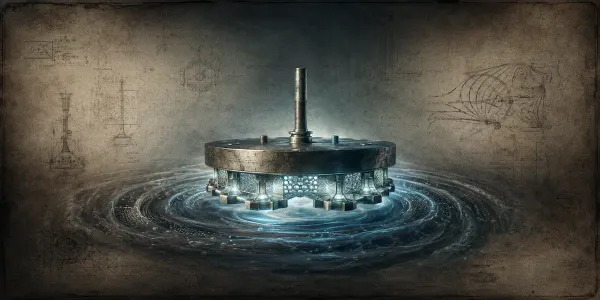
As for the platform itself - photographic documentation and a description of the construction have survived: a central column, handles, a plate, a control system and structures placed under the plate. According to some sources, a model of the device ended up in a museum, where over time the plate was lost and only the column remained.
The 1985 application was rejected - even the correspondence concerning this decision has survived (including a reply from a certain V.V. Sapelkin to Grebennikov and Grebennikov’s own reply), although the exact reason for the rejection requires further checking in the archives - the content of this correspondence has not yet been read by us in full.
The museum in Krasnoobsk - a concrete address, not a legend
One of the leads has been closed off: the museum where the platform model was said to be located is the real, existing V.S. Grebennikov Museum of Agroecology and Environmental Protection, located in Krasnoobsk near Novosibirsk, on the grounds of the Siberian Research Institute of Animal Husbandry (SibNIIZh). This is not an internet rumour - the institution is listed in local directories (e.g. 2GIS) and has been the subject of reportages.
According to journalistic accounts, among the museum’s exhibits, besides materials concerning Grebennikov himself, there are also completely different things - a cast of the foot of a supposed “yeti” donated by a 1986 expedition, or tektites (glassy geological formations) which one Siberian geologist linked to the hypothesis of extraterrestrial origin. This signals that the institution has the character of a broadly “frontier” museum of natural sciences and unexplained phenomena, rather than being exclusively an institute devoted to a single invention - which is worth taking into account when assessing the credibility of the information about the platform relayed there.
From the same circle of sources (an account published on the portal Проза.ру) comes the description that Grebennikov was said to have built an “emitter” based on strictly ordered honeycomb structures - an object said to be physically present in the museum - and that the effect of the interaction was said to be perceptible even when shielded by plastic covers. This is a second-hand account, not an independent measurement, so we treat it as an element of folklore around the subject, not a confirmed fact.
Schauberger - here the ground is far more solid
Whereas in Grebennikov’s case we are talking mainly about applications and publications, Viktor Schauberger left behind real, granted patents that can be checked in patent databases - and, on top of that, a physical archive that is still in operation.
The best known is AT 117749 B - “Strahlturbine” (jet turbine), filed in 1926 and granted in 1930 - a water turbine with a conical rotor and helical blades, using the vortical motion of a liquid. The list of his patents is much longer and includes, among others, river regulation, timber transport, the separation of assortments, spiral pipes for transporting liquids and gases (including patent AT 196680 B, filed in 1951 and granted in 1958, this time together with his son Walter), and soil-cultivation devices.
The PKS archive and Callum Coats’s book
The official list of patents is maintained by PKS (Pythagoras Kepler System) in Bad Ischl, Upper Austria - an institution that turns out to be more than just a website. PKS holds the physical archive of the Schauberger family and real prototypes of the devices - including the Repulsine and Viktor’s home energy generator - which are shown to visitors during periodic events (e.g. the ICOST conference), along with open days for the public at the PKS headquarters.
The most detailed secondary study based on this archive is Callum Coats’s book “The Energy Evolution” (the “Eco-Technology” volume, part 4), which contains a list of illustrations pointing to specific technical drawings, including:
- a diagram of the double spiral pipe (corresponding to several patents, including AT 196680 B),
- a diagram of the air turbine (patent no. 145141),
- a cross-sectional construction drawing of the Repulsator and its variant with a cooling system,
- sketches and a detailed drawing of the “Klimator” device,
- the patent drawing of the Repulsine no. 146141 together with a photograph of the patent itself,
- a sketch of the double membrane from the Repulsine patent,
- five photographs of the Repulsine itself.
The book’s editor notes explicitly that the identification of Schauberger’s individual machines is sometimes problematic, because in his own writings different devices are sometimes named ambiguously, and references to the accompanying sketches often point to materials that have not survived.
Repulsator and Repulsine - the wartime context, confirmed by the Mauthausen memorial
It is at this point that the story most often splits online: real wartime documents get mixed up with a later, heavily embellished legend about Nazi “flying saucers”. It is worth separating what the official memorial confirms from what comes exclusively from ufological sources.
According to the materials published by Mauthausen Guides - the official service of the Mauthausen Komitee Österreich (the association conducting educational activities at the former Mauthausen concentration camp), a subcamp called Schönbrunn did indeed exist, established in connection with Schauberger’s research into an alternative propulsion technology called “Repulsine”. As early as 1943 he was working with prisoners of KL Mauthausen on the development of a so-called flying disc, conducting experiments in parallel in fluid mechanics, energy production and alternative propulsion methods. Probably due to better infrastructure, his laboratory was moved to Schönbrunn - at the end of September 1944, several prisoners with the appropriate skills were transported for this purpose from Mauthausen to Vienna, to the Fasangarten barracks in the district of Hietzing. The exact location of the camp can no longer be determined today.
This is an important supplement: here we have confirmation from an institution dealing with the history and memory of the camp, not only from paranormal literature - although the source itself focuses on the history of the place and the victims of forced labour, not on assessing whether Schauberger’s devices actually worked.
The PKS archive, for its part, describes in its biography of Schauberger an earlier episode as well: his forcible placement in the psychiatric hospital in Mauer-Öhling, which was - according to this source - the result of an intrigue by the Vienna Association of Engineers, along with the constant SS supervision of his further work. The same material mentions Schauberger’s cooperation with the Messerschmitt plants on engine cooling systems and his correspondence with the designer Ernst Heinkel concerning aircraft engines - a separate, more “engineering” thread of his biography, independent of the camp thread.
The devices themselves - the Repulsator and the Repulsine - are described in the documents as “apparatus for carrying out organic syntheses”, using compressible, vortical forms of motion of liquids and gases. The precise technical data of both machines remain difficult to verify independently of what the PKS archive reports - after the war, all the documentation was said to have been confiscated by the Allies (Soviet, French, British and American forces), which is itself a claim difficult to verify today apart from the sources that side with the “Nazi UFO” legend.
What is biographically well documented, however, is the starting point of all of Schauberger’s work: the observation of trout standing motionless in a swift mountain current, which directed his attention to the particular properties of vortices and water flow. A biological observation and a hydrodynamic hypothesis are one thing; the claim of anti-gravity built on that basis is a completely different matter, not documented in the same way.
Film material - from the real archive to popular-science productions
On Schauberger’s side the situation is again clearly stronger than on Grebennikov’s - and here too it is worth separating the document from the legend.
Genuine archival material: “Tragendes Wasser” (1930)
The most important item is “Tragendes Wasser” (“Bearing Water”) - a film shot in 1930 (some sources say 1929) on commission from the Austrian tourist office (Österreichisches Fremdenverkehrsbüro), documenting the operation of Schauberger’s wooden log flume in the Mürztal valley near Neuberg. This is not material made by advocates or critics - it is a commissioned production of its time, showing a genuinely working engineering installation, for which Schauberger received a million schillings from the authorities as part of a contract (the installation was supposed to transport 1000 m³ of timber in an hour - it achieved 1400 m³).
The film’s fate is well documented: it was lost during the Second World War, and in 1961 its trace was found in an archive in East Berlin, from where copies reached biotechnical organisations in West Germany and Sweden. The surviving fragment is partly damaged, but it is still the best existing film evidence of these 20th-century flume constructions working - regardless of what one thinks of his later, far more speculative theories. Fragments of the film circulate online today (including on YouTube and Vimeo under the original title).
This is evidence of timber floating by Schauberger’s method - not of the Repulsine or anti-gravity. The two things should not be confused.
Later documentary and popular-science productions about Schauberger
A few newer films also circulate, clearly from the popular-science/paranormal documentary genre rather than source material:
- “Nature Was My Teacher - The Vision of Viktor Schauberger” (1993, narrated by Tom Brown, produced by Borderland Science Research) - an early English-language production, heavily popularising.
- “Water - The Great Mystery” a Russian-German documentary production about water as a phenomenon, in which themes connected with Schauberger’s ideas appear alongside statements by various scientists; it is clearly essayistic rather than source-based in character.
- Numerous shorter materials and podcasts (e.g. a 2018 episode of the “People & Place” series) discussing the book “Living Water” - these are secondary commentaries, not independent documentation.
None of these materials constitutes independent confirmation of the operation of the Repulsine or the Repulsator - they rely on the same sources (Schauberger’s writings, the PKS archive, Coats’s books) that we have already discussed above.
Grebennikov - far more modest material
On Grebennikov’s side I found no equivalent of “Tragendes Wasser” - that is, no independently commissioned, archival film documenting his work. What circulates online instead are video recordings referring to the title of his book “Мой мир” (including some dated 1996), published on YouTube by channels of a paranormal/ufological profile. These are not television or museum productions in the sense of official documentation - rather compilations of photographs and text fragments, so I treat them as part of the same internet folklore that the rest of the article tries to describe, not as a separate source of evidence.
The common denominator
Putting both researchers side by side, one concrete motif emerges - and in my opinion it is more interesting than the legend of “anti-gravity” itself:
- Grebennikov: microstructure → chambers → ordered geometry → interaction.
- Schauberger: water → vortex/spiral → flow geometry → a change in the characteristics of motion.
In both cases the starting point is not the search for a “new source of energy”, but the observation that a specific geometry and organisation of matter or motion changes the behaviour of a system. This is a far more modest and far more testable thesis than the popular version of “two people invented anti-gravity” - which is exactly why it is worth separating it from the rest.
What is documented and what is not
Finally, a distinction that easily blurs in internet stories:
Documented - the application 32-ОТ-11170 of 1985, the series of publications by Grebennikov and Zolotarev from 1984-1988 (including the specific, verified publication by Zolotarev and Shamshev in the scientific journal of the Ulyanovsk Polytechnic), Schauberger’s real, granted patents, the existence and activity of the PKS archive with its preserved original prototypes, the existence of the museum in Krasnoobsk near Novosibirsk, the existence of the Schönbrunn subcamp connected with Schauberger’s work on the Repulsine (confirmed by the official Mauthausen memorial), his biography and hydrodynamic observations, and the book “My World” from 1997.
Not independently confirmed - the anti-gravity effect itself attributed to Grebennikov’s platform and Schauberger’s Repulsine, the precise technical parameters and operation of both devices, the circumstances of the platform’s alleged dismantling by Grebennikov himself, and the content and exact reason for the rejection of application 32-ОТ-11170. There are descriptions, photographs and accounts, but I found no modern, independent verification that these devices actually worked as their creators or their advocates claimed.
This distinction does not diminish the matter - on the contrary, it makes it more interesting. Instead of a ready-made legend of “anti-gravity that was hidden”, we have a trace of real research, applications and patents that someone could still trace to the end today: the full text of application 32-ОТ-11170, the correspondence with the patent commission, the materials of the museum in Krasnoobsk itself, or the full archive of the Repulsine’s technical drawings at PKS.
Sources (links checked and working)
- Scans of the priority application no. 32-ОТ-11170 of 3.09.1985 - five photocopies of the original document (ogvsg.narod.ru archive)
- Publication on the application of the chamber-structure effect in megachilid breeding, 1986 - full text of the paper from a conference in Moscow
- “Расчет эффекта многополостных структур”, V.F. Zolotarev, 1987 - page with description and scans
- A. Frolov’s commentary on Zolotarev’s work (PDF, faraday.ru)
- The ogvsg.narod.ru archive - full list of documents and correspondence from 1985-1988
- “Мой мир” by Grebennikov (1997) - full text online, LibFox library
- V.S. Grebennikov Museum of Agroecology and Environmental Protection - catalogue entry, Krasnoobsk
- Reportage on the Grebennikov agroecology museum
- Patent AT 117749 B “Strahlturbine” (jet turbine), 1930 - Google Patents
- Patent AT 196680 B “Pipeline for liquid and gaseous media”, 1958 - Google Patents
- Official list of patents of Viktor and Walter Schauberger - PKS archive (Pythagoras Kepler System)
- Biography of Viktor Schauberger - PKS archive
- Callum Coats, “The Energy Evolution” (Eco-Tech, part 4) - full text, archive.org
- The Schönbrunn subcamp - official description, Mauthausen Guides / Mauthausen Komitee Österreich (EN)
- The Schönbrunn subcamp - German version
Note: the catalogue record of the Russian State Library for “Мой мир” exists, but the site blocks automated queries - which is why I linked a working version of the full text instead.
Theran
13.08.2026